
Two operational missile groups of the Indian Army -- one with the 150-250 km short-range Prithvi missiles and the other in charge of the longer-version 2,500 km Agni missiles, would form the nucleus of the new Strategic Forces Command.

The plan includes three such formations: A China-focused Northern Theatre Command, a Pakistan-focused Western Theatre Command, and a Maritime Theatre Command.
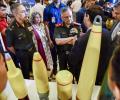
'General Subramani's appointment as military adviser in the NSCS has given him insight into decision-making at the apex level prior to formally taking over as CDS.'

Operation Sindoor compelled Pakistan to undertake constitutional amendments, which is an acknowledgement that things did not go well for the neighbouring nation, Chief of Defence Staff General Anil Chauhan has said.
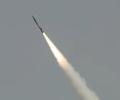
The army said the missile launch was part of "Exercise INDUS" without giving details about the exercise.

Following the new government's assumption of power, the Bangladesh Army has undergone a significant reshuffle, including the appointment of a new Chief of General Staff and changes in key strategic commands.

Troops of the Indian Army's Southern Command showcased their operational preparedness and integrated combat capabilities during Exercise Agni Varsha at the Pokhran Field Firing Ranges in Rajasthan.
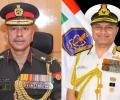
Lt Gen NS Raja Subramani (retd) has been appointed as India's next Chief of Defence Staff, succeeding Gen Anil Chauhan. Vice Admiral Krishna Swaminathan has been named the next Chief of the Naval Staff, succeeding Admiral Dinesh K Tripathi. Lt Gen Subramani's primary mandate will be to implement the military theaterisation plan and bolster tri-services synergy.
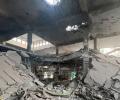
Pakistan is considering creating a new position of 'Commander of Defence Forces' (CDF) to improve coordination and unified command among its military services, according to media reports. The move is part of broader defence reforms and is reportedly influenced by recent conflicts and the evolving nature of modern warfare.

Asim Munir, who was promoted to the Field Marshal rank this year, will also simultaneously hold the office of the Chief of Army Staff, along with his duties as CDF.

On the first anniversary of Operation Sindoor, the Indian military issued a stern warning to Pakistan, stating that no terror sanctuary across the border is safe and that India will continue to dismantle terrorist infrastructure.
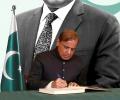
Pakistan has announced the creation of a new Army Rocket Force equipped with advanced technology to strengthen its combat capabilities. The announcement was made by Prime Minister Shehbaz Sharif, who also commented on the recent military confrontation with India and expressed gratitude to various countries for their support.

'In a volatile global market, India is pursuing a low-risk, low-return policy, akin to a SIP -- slow, steady investment.' 'Pakistan is following a high-risk, high-return policy.'

The Army paid a solemn tribute to Fazal, who died on Thursday after a brief illness. They remembered him as a "valiant son of the soil" who stood shoulder to shoulder with troops during Operation Sarp Vinash, which successfully dismantled terrorists' operational hub in Hill Kaka.

Iran has strongly criticised US plans to impose a blockade on its ports, warning that maritime security across the Persian Gulf region would be jeopardised if its own security is threatened.

Army officers share their experiences and details about the contingents and displays that will be part of the Republic Day Parade on Kartavya Path.
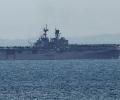
Although extensive air attacks have been carried out to destroy most of Iran's defence capabilities, the latter's resilience and sustenance during the war clearly indicate that the US landing force would encounter severe resistance in the operation, explains Commodore Venugopal Vengalil (retd).

According to an official Iranian military statement, Qader anti-ship cruise missiles were launched at the carrier, forcing it to alter its position in the region.

The Iranian military on Thursday issued a strongly worded response to remarks made by United States President Donald Trump, warning that the ongoing conflict will persist until Washington, DC faces what it described as 'permanent humiliation, regret, and surrender', as reported by Iranian state media Press TV.

'After the Galwan clash, the rules of engagement changed with the army commanders allowed to use any means at their disposal as they deem fit for tactical operations.'

The purge in Washington does not pause the war. Strikes continue, Hormuz remains closed, and Brent crude is still dancing around $109 a barrel. For India, the command chaos in the Pentagon is another layer of uncertainty piled on five weeks of conflict that was already straining every buffer Delhi has.
A spokesperson for the Central Khatam al-Anbiya Headquarters said that Iran's armed forces are prepared to intensify their response if aggression continues.

According to Iranian state media, Islamic Republic of Iran Broadcasting (IRIB), the threat was articulated by Ebrahim Zolfaghari, spokesperson for Iran's Khatam al-Anbiya Central Headquarters.

...reopen for up to six months. Until then, the Strait stays nearly closed. The world pays. And no one, including the man who started this, can say when it ends, notes Prem Panicker in his must read blog on the Iran War.

Pakistan on Saturday brought in a Constitutional amendment to create a new post of chief of defence forces to ensure greater coordination and unified command among the three services.

'As result, Netanyahu 'convinced' Trump to go to war with the help of overoptimistic Israeli intelligence assessments, essentially explaining to him that they only need to bomb Iran for 3-4 days, and the regime would then collapse.' 'Rather unsurprisingly, Netanyahu is ever since blaming his own intel service for the entire operation failing.'

The 'rescue' operation occurred within kilometres of Iran's underground tunnel complex at Isfahan, assessed by the IAEA and US intelligence as holding a substantial portion of the country's 60 per cent enriched uranium stockpile. Retired senior US military officers have highlighted that the mission's footprint -- hundreds of special operators, multiple heavy-lift aircraft deep inside Iran -- appears outsized for recovering a single airman. Prem Panicker continues his must read blog on the Iran War.

Trump may strike. He may announce productive talks and extend again. He may do both at the same time. Iran will not open the Strait on someone else's terms, so no matter what happens, that problem will remain unsolved. And the IRGC will still be collecting its $2 million toll from every ship bold enough to ask permission to pass.

India successfully test-fired nuclear-capable short range ballistic missiles Prithvi-II and Agni-I from an integrated test range off the Odisha coast, demonstrating its strategic deterrence capability. The test-firing of the missiles, conducted by the elite Strategic Forces Command, validated all operational and technical parameters.

India has firmly denied allegations that the US Navy is using its ports to launch attacks against Iran, reaffirming its commitment to strategic autonomy and non-alignment in international conflicts.

AI reduces the time taken to find a target and launch a strike. This has led to a major increase in the pace of the conflict, with one report mentioning nearly 900 strikes launched on Iranian targets in the first 12 hours of an operation.

Trump seems to have estimated that Ghalibaf is a pragmatic politician who is receptive to close relations with the US and is enthusiastic about fostering business and economic ties in particular, points out Ambassador M K Bhadrakumar.

General Manoj Mukund Naravane's memoir has triggered a controversy by revealing behind-the-scenes decision-making during the 2020 India-China standoff in Ladakh. Its candid account of military and political responses at a critical moment has reignited debate over civil-military relations, accountability, and the limits of disclosure in matters of national security.
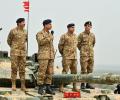
'Can a nuclear-armed nation sustain itself indefinitely under overt military rule without catastrophic consequences for itself and the region? History suggests otherwise.'

If Xi Jinping can establish control over the PLA Ground Force, relations between India and China will settle down to an even keel. The next few weeks will show whether Xi has finally succeeded in gaining control over the PLA Ground Force. That could bring about the substantive shift in India-China relations that both our leaders have been working for, observes Ambassador Prabhat Shukla.

Iran is fighting a different war: Older, slower, and in some ways more dangerous. Iran doesn't need to shoot down an F/A-18. It only needs to make the Strait of Hormuz feel dangerous long enough for insurance markets, shipping companies, and oil futures traders to do the rest. Prem Panicker continues his must-read daily blog on the war in the Middle East.

Protesters in Berlin told EuroNews that they hoped their activism would lead Europe and the United States to assist the Iranians in their struggle to topple the regime.
For the first time, an Army General is set to take over command of the country's strategic forces and nuclear arsenal. Lt-Gen Balraj Singh Nagal will take over command of the country's strategic forces and nuclear arsenal, an official announcement said.
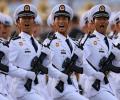
China's latest defence budget surges to $275 billion, fueling its ambitious military modernisation program and intensifying geopolitical dynamics in the region.
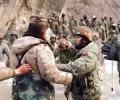
'Critics say the political leadership abandoned the army chief or did not back him. I disagree. 'Military leaders are trained to take decisions when given a free hand.' 'This was a clear go-ahead from the prime minister to the army chief.'
 © 2026 Rediff.com - Advertise with us - Disclaimer - Privacy Policy - Sitemap - Feedback - About us - Terms of use - Grievances